
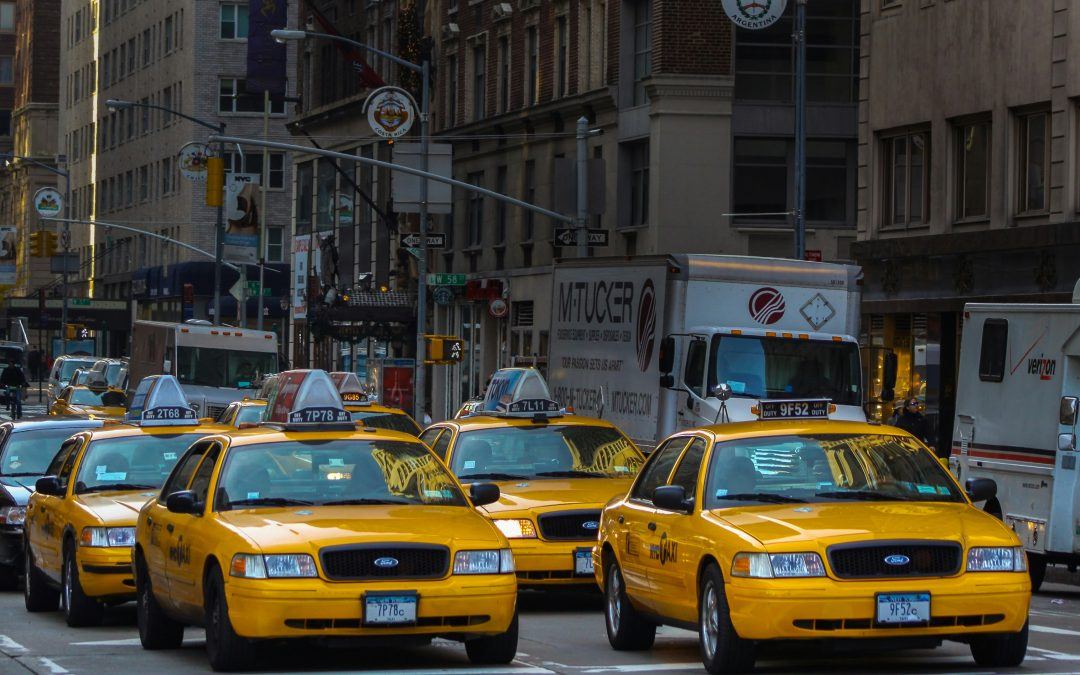
The Shift
There was a time when, if you needed a ride somewhere, you had one primary option – you called a classic taxi service. No matter where you were, and where you wanted to get to, taxis were the default option.
Fast forward a decade or two, and suddenly every person living in a mid-sized city is overwhelmed with choices about how to get from Point A to Point B. Sure, you might still call a taxi…but what about an Uber? Or a Lyft? What about taking the bus, or the subway? What about using a bike-share program? Or maybe an electric scooter?
The options are numerous, but each one exists for a reason — it helps people get from where they are, to where they want to be, in whatever way works best for them.
Similarly, there was also a time when, if you wanted to “succeed” in the professional world, you had a single option — you went to school and followed the standard pathway through to college. No matter where you lived, or what you wanted to do, a traditional education was most often the precursor to economic mobility and success.
Fast-forward to 2024, and you arrive in the information age — where school is just one of the many options available to young people for learning, for growing, and for preparing themselves to enter the workforce.
And, let’s face it, next to YouTube and Khan Academy…the typical constraints of brick-and-mortar schools have rendered them unappealing to many young people. Most traditional settings are marked by boredom, rigidity, and irrelevance at best — for many young Americans, they are symbolic of brutal inequity, systemic racism, and dehumanization, where they experience siloed learning with limited connection to transferable skill development.
So, what is to be done? Should we fight tooth-and-nail to get our kids back into their seats and return to being “schooled” the same way it’s always been done? To start giving tests and quizzes again, as the main way of measuring learning? To get the vast and clunky machinery of the industrial education system up and running?
Or… should we use this moment as an opportunity to look ahead, at the next horizon, and imagine a system that is designed for the modern world?
The Opportunity
At reDesign, we believe the time is ripe for boldness and bravery, for creativity and community. We have an opportunity in this moment to redefine the essence of learning, to wrestle it free of an antiquated system that tethers learning to one place, at one time, in one way. We have an opportunity to embrace a vision of education that is not confined to the four walls of a classroom or any one subject area, but spills out into every aspect of our lives. We have an opportunity to re-define the why, the when, and the how of learning for young people everywhere.
And at reDesign, we don’t like to let opportunities slip away.
That’s why we built the reDesign Future9 Competencies — a framework that outlines nine different social, emotional, cognitive, and academic skill-sets that we believe will prepare young people for the future. The Future9 includes developmental continuums for each skill so that anyone, anywhere, can measure the learning matters.
To us, this framework is not about getting us back to “normal”. We’re not interested in giving our old car or taxi a new paint-job, and calling it a day. We’re rethinking the concept of a car, and what it really means to give people the freedom to go where they want to in their lives.
The Future9 Competencies are an attempt at reimagining learning for the future — a future where learning breaks down the wall between the classroom and the world beyond; where learners build essential skills through experiences that tap into their curiosity and passion; where our system reflects a society whose diversity is its collective wealth. In short, a future where learning is infused with relevance, with meaning, and with inclusivity.
In these ways, and many others, we hope that the Future9 Competencies can begin to shape a vision for the future of learning that meets those goals. We hope for this to be a paradigm-shift in our education system, in our society — one that asks us to look in the mirror, consider why things are the way they are, and boldly change them for the better.
As with so many of our modern world’s systems, structures, and traditions, we have lost sight of our education system’s original purpose. As we seek to develop future generations of thoughtful, skillful, creative citizens of society, we must consider how best to approach this lofty collective ambition. Truthfully, school is no longer the only path towards an education, just as taxis are no longer the only way to get from one place to another.
And so, we need to ask ourselves: What are we committed to? Using taxis? Or improving travel?
Join the community!
Sign up to receive our newsletter, access best-of educational resources, and stay in the know on upcoming events and learning opportunities. We hope to see you soon!
